Lithium
A trace element that might protect nerve cells at low doses. I have been taking it since 2024.
Updated: October 2026
What is it?
Lithium is a trace element that occurs naturally in small amounts in drinking water and food. At high doses, it has been a drug for bipolar disorder since 1949. For Parkinson's and Alzheimer's, researchers are interested in very low doses. As a supplement, lithium orotate is usually used.
What does the research say?
Lithium acts on several points that play a role in Parkinson's: it inhibits the enzyme GSK-3β, which is involved in inflammation and in the death of nerve cells, increases the growth factor BDNF, stabilizes the mitochondria and promotes the cells' self-cleaning (autophagy).
- 2025, Alzheimer's: Harvard Medical School reported in Nature that people with Alzheimer's have clearly less lithium in the brain. In mice, lithium orotate at a very low dose reversed the typical changes. However, the researchers warn against taking lithium on your own as long as studies in humans are missing.
- Parkinson's, University at Buffalo: A pilot study with 16 patients (2023) showed that lithium can raise a protective protein for dopamine nerve cells in the blood. In a follow-up study, 15 patients in the early stage received lithium for 24 weeks. The combined analysis in 2026 with 28 patients found: at the highest lithium levels, neurofilament, a marker for the breakdown of nerve cells, dropped by just under 13 percent on average. But there was no placebo group.
- Ongoing study: In a randomized, placebo-controlled study, the University at Buffalo is testing 20 mg of lithium daily in 20 early-stage patients, over 24 weeks and with modern biomarkers such as MRI, neurofilament and the protective protein Nurr1 (study NCT06339034). It is supported by the British foundation Cure Parkinson's. Enrollment is complete, and the study is scheduled to finish in fall 2026. I will add the results here as soon as they are published.
So far, there is no evidence of an effect on symptoms or on the course of the disease.
My experience
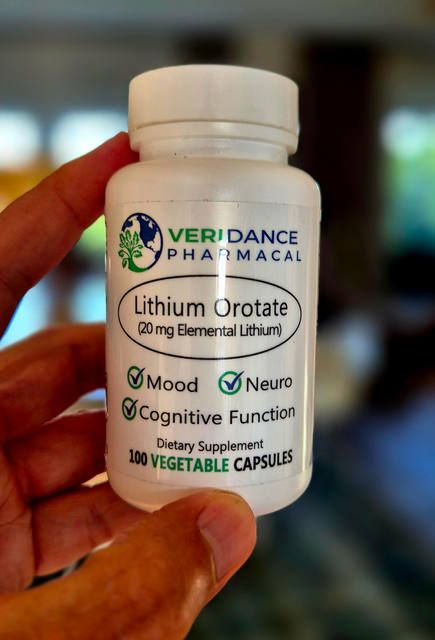
At the end of August 2024, I started with a low dose of lithium orotate, at first 5 mg, and increased the amount over time. Now I take one capsule a day with 20 mg of elemental lithium (about 577 mg of lithium orotate, according to the manufacturer). That is clearly more than the microdose of about 1 mg that is often mentioned for healthy people, but far below the doses used for bipolar disorder.
That is exactly why I have my blood values checked regularly, especially kidneys and thyroid. So far, everything has been normal. My lithium level in whole blood on October 7, 2025 was 88.8 µg/l (at 5 mg a day back then); the range for preventive medicine is given as 25 to 350 µg/l. My 2026 value was normal as well.
Since I started taking it, I feel more relaxed. I have not noticed a direct effect on my symptoms. I take lithium mainly because of its possible protective effect on the brain.
The physician Dr. Michael Nehls has done pioneering work here, among other things with his book "Das Lithium-Komplott" ("The Lithium Conspiracy"). On his homepage he explains the background.
Lithium in mineral water
You can also take in lithium through mineral water. Some brands with a high content (mg per liter):
- Bad Mergentheimer Albertquelle: 13.0
- Staatliches Bad Kissinger Rakoczy: 5.0
- Bad Mergentheimer Karlsquelle: 4.9
- Rogaska Heilwasser: 3.3
- Hirschquelle: 1.3 (often at Rewe)
- Bad Vilbeler Römerbrunnen: 1.2
Measuring lithium levels
It is measured with the ICP-MS method in EDTA whole blood, for example at biovis, at IMD Berlin (also as a self-pay test) or at Medizinisches Labor Bremen.
Effort and cost
Lithium orotate is inexpensive. Pay attention to the label on the pack: some manufacturers state the elemental lithium, others the lithium orotate. As a rule of thumb, 100 mg of lithium orotate contains only about 3.5 mg of elemental lithium. So a capsule with "5 mg lithium" contains about 143 mg of lithium orotate. In Germany, lithium in this form is only available by prescription from the pharmacy, for example following Dr. Nehls's formula.
Important: at higher doses, lithium can damage the kidneys and thyroid and can interact dangerously with other drugs, for example with some blood pressure medications and painkillers.
My conclusion
For me, lithium is an exciting building block with an eye to the future, but research in humans is still at the beginning. Only take it in consultation with a doctor who knows about low-dose lithium, and have your blood values checked regularly.