TPS Neurolith
Sound pulses through the skull, once a month. One of my three most important building blocks since 2021.
Updated: October 2026
What is it?
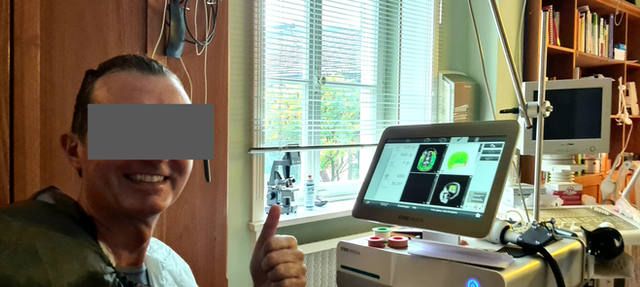
In Transcranial Pulse Stimulation (TPS), short sound pulses, known as shock waves, are directed through the skull into specific brain regions. You sit relaxed in a chair while the doctor moves a handpiece over your head. There is no incision, no anesthesia and no medication.
The device is called NEUROLITH and comes from the Swiss company Storz Medical. It has been approved for Alzheimer's since 2018, and for Parkinson's it is used off-label. The pioneer in Parkinson's was Dr. Lohse-Busch, the first doctor to use shock waves for Parkinson's.
The shock waves are meant to stimulate neuroplasticity, the brain's ability to form new connections. In the lab and in Alzheimer's patients, new blood vessels, reactivated nerve cells and an increase in the cerebral cortex were observed.
What does the research say?
For Parkinson's, the research is still young:
- Vienna, 2023/2024: The team led by Prof. Roland Beisteiner looked back at the treatment of 20 patients and found a clear improvement in motor function (Journal of Neurology).
- Harvard Medical School, 2025: 14 patients received twelve sessions over four weeks. UPDRS Part III improved by almost five points on average, thinking, mood and quality of life also improved, and the effect lasted one month after the end of treatment (Journal of Neurology 2026). There was no control group.
- Vienna, with sham treatment: 30 patients with mild Parkinson's received both a real and a sham treatment. Fine motor skills of the hands improved much more after the real one, and MRI showed changes in the treated regions. But general motor function improved similarly after both. This shows how large the placebo effect can be.
- Trieste, 2026: An Italian study confirmed TPS as a safe add-on treatment, among other things for resting tremor.
- Survey of doctors: About 80 percent of treated patients benefited, but for some it does not work at all.
In summary: There are serious signs, especially for fine motor skills. Larger controlled studies are still missing.
My experience
From September 29 to October 6, 2021, I received my first six treatments. Since November 2021, I have gone once a month for a booster session, and since October 2022 at the practice of Dr. de Abos y Padilla in Mannheim (Neurostimulation Mannheim). So far I have had no side effects.
In the fall of 2021, when I started TPS, PDCare, the Vielight helmet and homeopathy at the same time, the decisive turning point came. I can't say how much of it was due to TPS. For me, it is one of the three most important building blocks.
Effort and costs
You usually start with six sessions within two weeks, and you need an MRI of the head beforehand. So getting started costs about 3,500 to 4,000 euros, and after that each booster session costs about 450 euros. My private health insurance covers a large part. In Germany, statutory health insurers usually do not pay. There are more than 90 treatment centers worldwide, about 40 of them in Germany (tps-neuro.com).
Reports by Dr. Lohse-Busch
- TPS in Parkinson's, Dr. Lohse-Busch, PDF (German)
- TPS in Parkinson's, Dr. Lohse-Busch, PDF (English)
My conclusion
For five years, TPS has been a fixed building block of my path, and I don't want to do without it. But its effect in Parkinson's has not been finally proven, and it does not work equally well for everyone. Get advice from an experienced doctor.